

Blog

What Should You Know Before Buying a Flat From a Builder?
November 14, 2026
What Should You Know Before Buying a Flat From a Builder?
Buying a flat directly from a builder is the most common route for home buyers in Mangalore. It gives you a brand-new home, modern amenities and a clear paper trail, but it also means you are trusting one company with a very large amount of money. A little homework before you book can protect you from delays, hidden costs and legal trouble. Here is a simple guide to what you should know.
Start with the Builder, Not the Brochure
Before you fall in love with a project, look closely at the builder. A good brochure costs very little, but a good track record takes years to build. Check how many projects the builder has completed, whether they were delivered on time, and what the buyers say about construction quality and after-sales service. Visit one or two completed projects and speak to the residents if you can. Their honest feedback will tell you more than any advertisement.
Look for independent proof of quality too. Ratings from agencies such as CRISIL, quality certifications like ISO and membership of bodies like IGBC show that a builder follows set standards. Years in business also matter, since a builder with decades of experience has usually seen and solved the problems that new players are still learning about.
Check the RERA Registration
RERA registration is the first legal check for any project. Every ongoing residential project above the prescribed size must be registered, and the registration number should be clearly shown in the builder's advertising. Take that number and verify it yourself on the official Karnataka RERA website. There you can see the project details, the promised completion date, the approved plans and the promoter's information. Never rely on the builder's word alone. If a project has no RERA number, or the number does not match, walk away.
Verify Land Title and Approvals
A beautiful building on disputed land is a nightmare. Ask to see the land ownership documents and confirm that the title is clear, with no pending litigation or loans against the property. Check that the builder has the sanctioned building plan from the local authority, the commencement certificate, and the required clearances such as fire safety and environmental approvals where applicable. It is wise to have a lawyer review these papers before you pay any significant amount. The cost of a legal opinion is tiny compared with the value of your flat.
Understand the Real Price of the Flat
The price quoted in an advertisement is rarely the full price. Ask for a detailed cost sheet and look for every extra charge. Common additions include:
Floor rise charges that increase the price as you go higher
Parking charges,if parking is not included
GST,which applies to under-construction flats but generally not to flats with a completion certificate
Stamp duty and registration charges
Clubhouse, maintenance deposit and corpus fund
Legal and documentation fees
Electricity, water and gas connection charges
Add all of these up before comparing two projects. A flat that looks cheaper on paper can easily become the more expensive option once everything is included.
Check the Carpet Area, Not Just the Size
Builders often advertise the super built-up area, which includes your share of common spaces like lobbies, staircases and lifts. The carpet area is the actual usable space inside your flat. Two flats with the same advertised size can have very different carpet areas. Ask for both numbers in writing, and compare projects on carpet area so you know exactly how much living space you are paying for.
Read the Payment Plan Carefully
For under-construction flats, payments are usually linked to construction stages, such as foundation, slabs and finishing. This is a fair system, because you pay as the work progresses. Make sure the plan in your agreement matches the stages mentioned by the builder, and that you are never asked to pay a large chunk before the work reaches that stage. Always pay through cheque or bank transfer, and keep every receipt. Avoid any request for cash payments, since these leave no record and can create serious problems later.
Study the Sale Agreement Line by Line
The agreement for sale is the most important document in the entire purchase. It decides your rights and the builder's duties, so do not sign it in a hurry. Pay special attention to these points:
- The exact unit number, floor, carpet area and parking slot
- The promised possession date and the penalty if the builder is late
- The detailed specifications of fittings and finishes
- The payment schedule
- The conditions under which you can cancel and get a refund
- The defect liability period after possession
Have a lawyer read the full agreement and explain anything you do not understand. If the builder refuses to put a promise in writing, treat that as a warning sign.
Ask About Possession and Delay
Even good builders can face delays because of approvals, weather or material shortages, so ask how the builder handles them. Check the possession date in the RERA record and compare it with what you are being told. Look at the builder's past projects to see if they were delivered close to the promised dates. Under RERA, a builder who delays possession must compensate the buyer, but it is far better to choose a builder who rarely needs to.
Look at the Amenities and Specifications
Amenities should match the price you are paying. Check what is actually included in the project, such as lifts, power backup, security, water supply, waste management and parking, and compare these with what is written in the agreement. Ask for the specification sheet, which lists the flooring, fittings, doors, windows and electrical points. For example, Land Trades projects like Pristine and Expertise Enclave publish details such as rainwater harvesting, sewage treatment, power backup and EV charging provision, which is the kind of clear information you should expect from any builder.
Check Loan Approvals and Bank Tie-ups
If you plan to take a home loan, find out which banks have approved the project. Bank approval is a good sign, because banks check the legal documents and the builder's credentials before they agree to lend. A project approved by several well-known banks gives you more choice on interest rates and loan terms, and makes the loan process smoother.
Visit the Site and Talk to People
Nothing replaces a site visit. Go to the project, look at the construction quality, and see the model flat if available. Visit at different times of the day to understand traffic, noise and sunlight. Check the neighbourhood for schools, hospitals and markets. If the project is under construction, compare the actual progress on site with what the builder claims. Many builders also share monthly construction updates, which is a good sign of transparency.
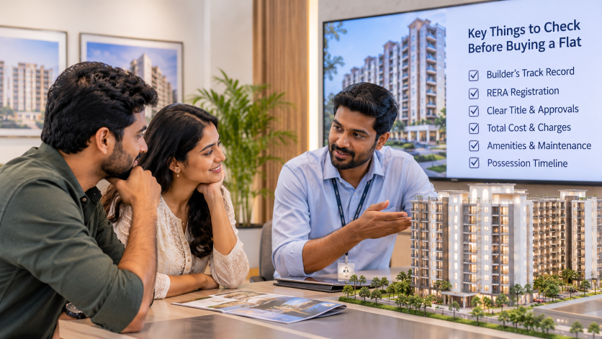
A Quick Checklist before You Book
- Builder's record: Completed projects, delivery history and certifications
- RERA number: Verified on the official Karnataka RERA website
- Title and approvals: Clear land ownership and sanctioned plans
- Full cost sheet: Every charge listed, including GST and registration
- Carpet area: Confirmed in writing
- Payment plan: Linked to construction stages, paid by bank transfer
- Sale agreement: Reviewed by a lawyer
- Possession date: Matched with RERA and past delivery record
- Bank approvals: Checked before applying for a loan
- Site visit: Done at least once, preferably twice
Buy with Confidence from Land Trades
Land Trades has been building homes in Mangalore since 1992, with RERA-registered projects, clear titles and transparent pricing. Our team is happy to share the cost sheet, the approvals, the specifications and the construction progress of any project, so you can make your decision with complete clarity. Contact us today or visit our website to explore our current projects and book a site visit.